
Metabolic Associated Steatotic Liver Disease (MASLD) is increasingly recognized as a major global health concern, closely linked to metabolic conditions such as obesity and Type 2 diabetes. While awareness and diagnostic capabilities have improved in recent years, managing MASLD remains challenging, particularly when it comes to assessing treatment response over time.
With the therapeutic landscape evolving, including the introduction of pharmacological treatments alongside established lifestyle interventions, clinicians are now faced with an important question: how can we reliably monitor whether a patient is improving?
The Challenge of a Silent and Dynamic Disease
MASLD often progresses without clear symptoms, especially in its early and intermediate stages. Patients may feel well even as underlying liver injury continues. This disconnect makes objective monitoring tools essential, particularly when evaluating the effectiveness of treatment.
At the same time, MASLD is not a static condition. Disease activity can fluctuate depending on metabolic control, weight changes, or therapeutic interventions. As a result, clinicians require tools that can capture ongoing biological processes, rather than relying solely on static or structural assessments.
Limitations of Current Monitoring Approaches
Liver Enzymes (ALT, AST)
Liver enzymes are widely used in clinical practice but have important limitations. Many patients with MASLD may present with normal ALT and AST levels despite ongoing liver injury, while others may show fluctuations that do not reflect meaningful histological changes. As such, liver enzymes alone are often insufficient to monitor treatment response.
Imaging Techniques
Non-invasive imaging tools, such as ultrasound or elastography, provide valuable information about liver fat and fibrosis. However, these methods primarily assess structural changes and may not capture early or dynamic changes in disease activity, particularly in response to short-term interventions.
Liver Biopsy
Liver biopsy remains the reference standard for assessing disease activity and fibrosis. However, its use in routine follow-up is limited due to:
- – Invasiveness and patient burden
- – Sampling variability
- – Cost and logistical constraints
For these reasons, repeated biopsies are not practical for monitoring treatment response in most patients.
A Growing Need in the Era of MASLD Treatment
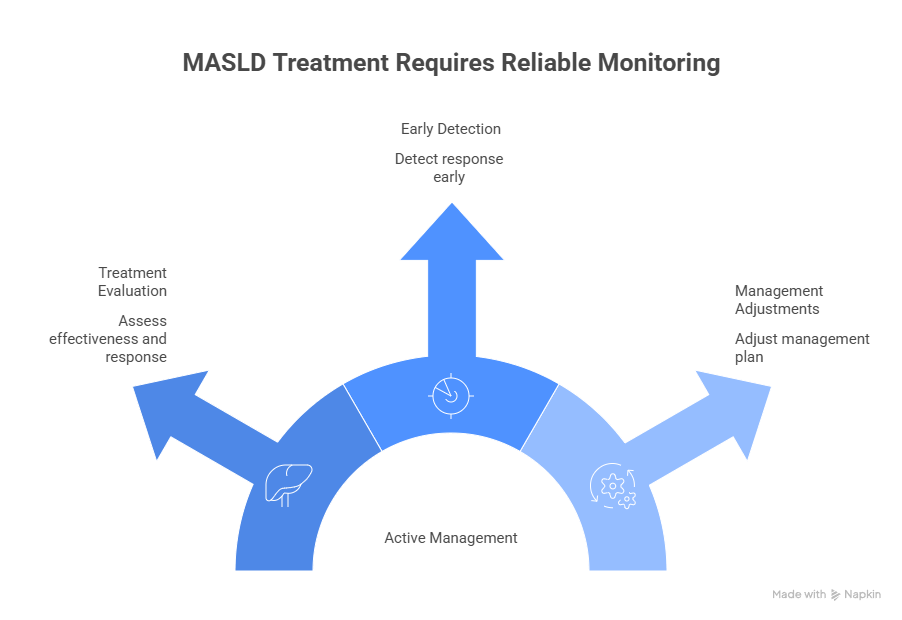
The need for reliable monitoring tools has become even more pressing as MASLD enters a new phase of active management. With the development of pharmacological therapies, alongside lifestyle and surgical interventions, clinicians must now evaluate:
- – Whether a treatment is effective
- – How early a response can be detected
- – Which patients may require adjustments in their management plan
This shift highlights a clear gap in current clinical practice: the lack of accessible, non-invasive tools that reflect ongoing liver injury and response to therapy.
Moving Toward Biological Markers of Disease Activity
To address these challenges, attention will increasingly turn toward biomarkers that reflect underlying disease mechanisms, rather than only structural liver changes.
One such mechanism is hepatocyte apoptosis, a key feature of MASLD progression, particularly in metabolic dysfunction-associated steatohepatitis (MASH). Measuring this process may provide a more direct insight into active liver injury and how it changes over time.
Biomarkers targeting apoptosis, such as those detecting fragments of keratin-18, have therefore been explored as tools to support treatment monitoring and improve clinical decision-making.
Looking Ahead
As MASLD management continues to evolve, the ability to monitor treatment response accurately and non-invasively will be critical. Understanding how different tools reflect disease activity, and how they can be integrated into clinical practice, will play a central role in improving patient outcomes.
In the next post in this series, we will explore how treatment monitoring is becoming increasingly important in the context of emerging pharmacological therapies, and how biomarkers are being used in clinical trials to assess response.